
Microsoft Earnings Today: What to Expect From Azure, AI and MSFT Stock
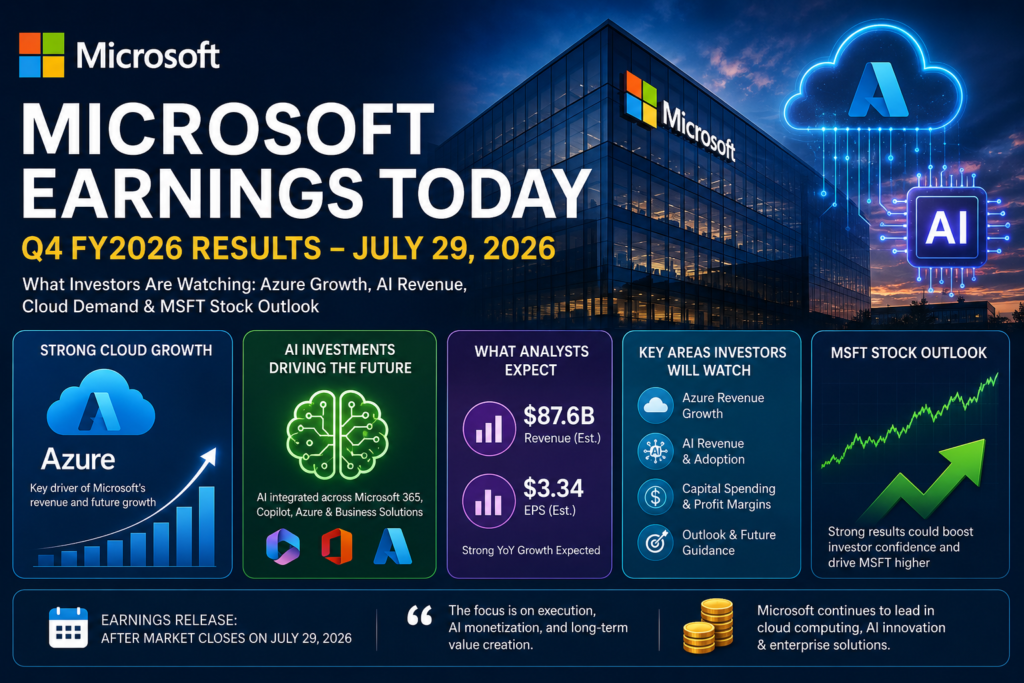
Microsoft is set to report its fiscal fourth-quarter 2026 earnings after the US stock market closes on Wednesday, July 29. The report is expected to be one of the most closely watched technology earnings events of the year because investors want answers to a major question: Are Microsoft’s massive investments in artificial intelligence producing enough growth to justify the cost?
Microsoft’s cloud business, Azure platform and AI products are expected to remain at the centre of attention. However, revenue and earnings numbers may not be the only factors moving MSFT stock. Investors will also examine the company’s future guidance, capital expenditure plans and comments about demand for AI services.
When Will Microsoft Report Earnings?
Microsoft is scheduled to release its fiscal Q4 2026 financial results after the market closes on July 29, 2026. The company will also hold an earnings conference call where executives are expected to discuss business performance, future growth and major investment priorities.
For investors, the earnings call may be just as important as the financial report because management commentary can influence expectations for the next quarter and beyond.
What Are Analysts Expecting From Microsoft?
Market estimates ahead of the report suggest that Microsoft could deliver approximately $87.6 billion in quarterly revenue, with earnings per share expected to show strong year-over-year growth.
These estimates may change as analysts update their forecasts, but the overall expectation is that Microsoft will continue benefiting from demand for cloud computing and AI-powered business services.
The company’s previous quarter provides important context. Microsoft reported revenue of $82.9 billion in fiscal Q3 2026, representing 18% growth from the previous year. Its operating income reached $38.4 billion, showing that the company remained highly profitable while continuing to invest heavily in AI infrastructure.
Why Azure Growth Matters So Much
Azure is one of Microsoft’s most important growth engines. Businesses use Azure to run applications, store data, build digital services and access advanced AI computing.
As more companies adopt generative AI, demand for cloud infrastructure has increased. Microsoft is attempting to convert this demand into long-term revenue through Azure, AI services and enterprise software.
Investors will closely watch:
- Azure revenue growth
- Demand for AI computing
- Growth in cloud services
- New enterprise customers
- Management’s outlook for future cloud demand
A strong Azure performance could support confidence in Microsoft’s long-term growth strategy. On the other hand, slower-than-expected growth could raise concerns about whether AI demand is keeping pace with the company’s spending.
Can Microsoft Turn AI Investment Into Revenue?
Microsoft has invested heavily in artificial intelligence across its products and infrastructure. AI features are now integrated into services such as Microsoft 365, Copilot, Azure and business software.
The company’s strategy is not limited to developing AI tools. Microsoft is also building the computing infrastructure needed to support large AI models and growing customer demand.
The key issue is whether these investments are generating enough revenue.
Investors are likely to look for evidence that:
- More businesses are paying for Microsoft AI products.
- Copilot adoption is increasing.
- AI services are contributing to Azure growth.
- AI spending can produce long-term profits.
- Demand remains strong despite higher costs.
Microsoft has already reported that AI infrastructure investment has supported growing usage of Microsoft 365 Copilot and cloud services. However, the company still faces pressure to demonstrate that AI can become a large and sustainable source of revenue.
Microsoft’s AI Spending Is Under Scrutiny
Building AI infrastructure is expensive. Data centres require advanced chips, networking equipment, electricity and large-scale computing capacity.
Microsoft’s capital spending is therefore likely to be a major topic during the earnings call.
High investment can be positive if it allows the company to capture future demand. However, investors may become concerned if spending rises faster than revenue or if profit margins begin to decline.
The market will likely focus on the balance between:
- AI infrastructure spending
- Revenue growth
- Cloud demand
- Operating margins
- Future profitability
Microsoft’s management may also provide guidance about expected spending in fiscal 2027.
What Could Move MSFT Stock After Earnings?
Microsoft stock could experience significant volatility after the results are released. Options-market activity has suggested that investors expect a larger-than-usual move following the report.
Several factors could influence the stock price.
A Positive Scenario
MSFT stock could benefit if Microsoft:
- Reports revenue above expectations
- Delivers strong Azure growth
- Shows increasing AI revenue
- Provides optimistic guidance
- Demonstrates that AI spending is producing measurable returns
A Negative Scenario
The stock could face pressure if:
- Azure growth slows unexpectedly
- AI revenue disappoints
- Capital spending rises sharply
- Profit margins weaken
- Management provides cautious guidance
Even strong earnings may not guarantee a higher stock price. If investors already expect excellent results, Microsoft may need to exceed expectations by a wide margin.
Microsoft vs Other Big Tech Companies
Microsoft’s earnings are part of a broader test for the technology industry.
Large technology companies are investing billions of dollars in AI data centres, advanced chips and cloud infrastructure. Investors increasingly want to see evidence that these investments can create long-term revenue and profit.
Microsoft is considered one of the strongest companies in enterprise AI because it already has a large business customer base and a broad ecosystem of software products.
Its ability to connect AI tools with Microsoft 365, Azure and other business services could provide an advantage over companies that rely on only one major product category.
What Microsoft’s Earnings Could Mean for the AI Industry
Microsoft’s results may influence more than just MSFT stock.
Strong cloud and AI growth could increase confidence in:
- Enterprise AI adoption
- Cloud computing demand
- Data-centre investment
- AI software companies
- Semiconductor and chip companies
Weak results could create new concerns about whether the technology industry is spending too aggressively before AI revenue becomes large enough to support those investments.
For this reason, Microsoft’s earnings report may affect sentiment across the wider technology market.
Final Thoughts
Microsoft’s Q4 FY2026 earnings report is expected to be an important test of the company’s AI strategy.
Revenue and earnings will matter, but the biggest questions are likely to involve Azure growth, AI monetisation, capital expenditure and future guidance.
Microsoft has already demonstrated strong growth in cloud computing and enterprise software. The next challenge is proving that its large AI investments can create sustainable revenue while maintaining strong profitability.
Investors, technology analysts and AI industry observers will be watching closely for signs that Microsoft’s AI strategy is moving from rapid investment to long-term financial returns.
Disclaimer: This article is for informational and educational purposes only. It does not constitute financial, investment or trading advice. Stock prices can be volatile, and readers should conduct their own research before making financial decisions.