
AI Agents 2026 Are Changing How We Use AI in 2026
Artificial intelligence has moved far beyond simply answering questions.
A few years ago, using an AI tool usually meant typing a prompt, waiting for an answer, and then doing the rest of the work yourself. In 2026, that model is beginning to change.
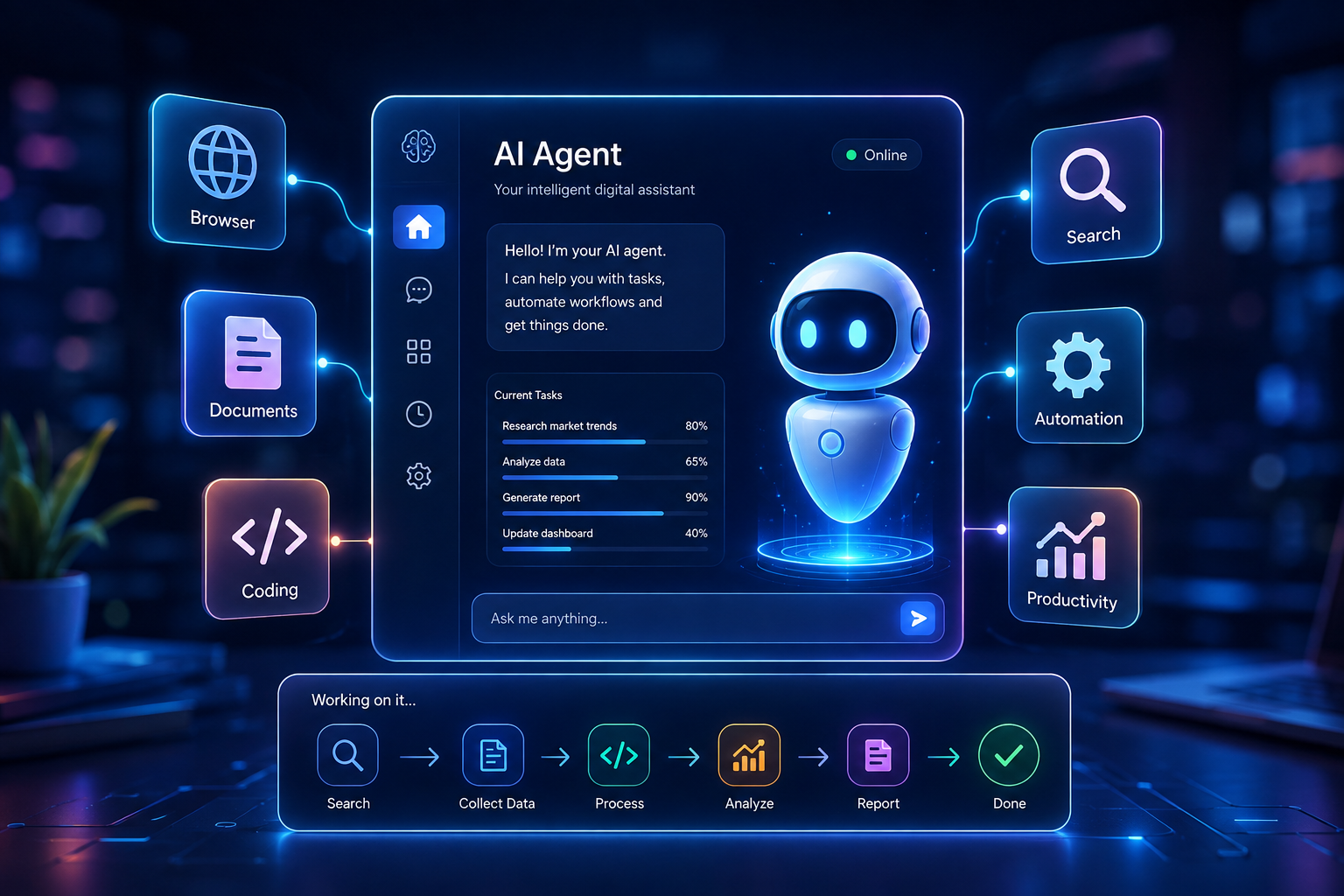
The biggest trend in AI right now is AI agents — systems that can understand a goal, use different tools, work with files and websites, complete multiple steps, and sometimes perform tasks with limited human supervision.
Instead of saying, “Tell me how to do this,” users can increasingly tell AI, “Do this for me.”
That difference may sound small, but it represents a major shift in how people interact with technology.
Recent research and industry data suggest that organizations are increasingly moving from AI assistance toward AI delegation. OpenAI’s latest enterprise data, for example, describes a shift from assistance to execution, with more work being delegated to agents.
So, what exactly are AI agents, which AI tools are leading this trend, and should ordinary users start using them?
Let’s break it down.
What Are AI Agents?
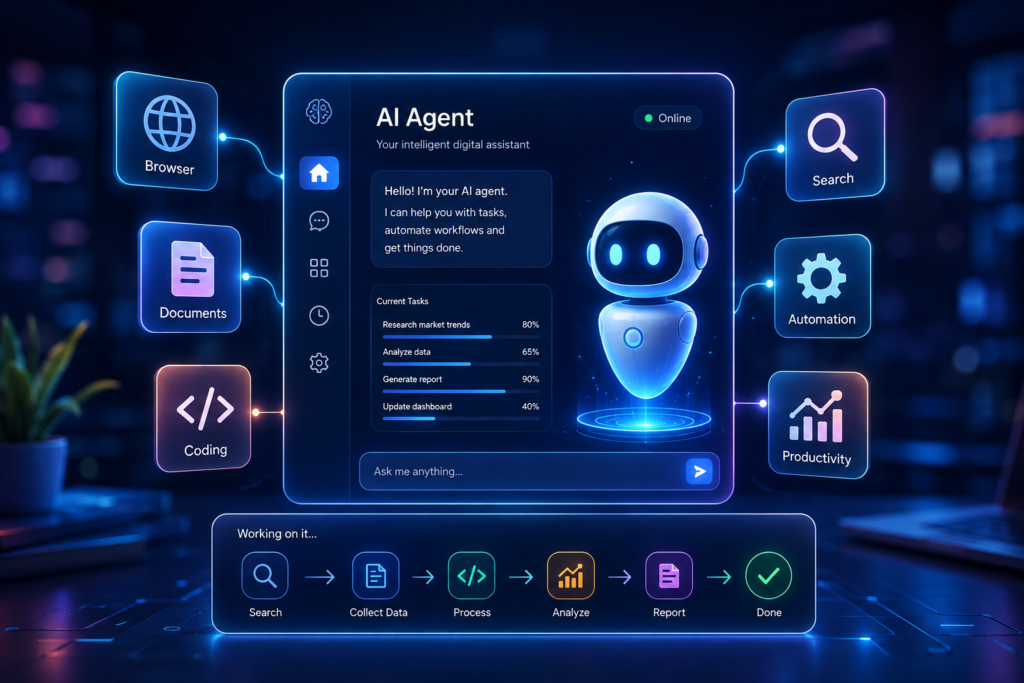
An AI agent is an AI system designed to do more than generate an answer.
A traditional chatbot might respond to a question such as:
“Write me a marketing plan.”
An AI agent could potentially take that goal further by researching information, organizing the results, creating documents, analyzing data, and completing several connected tasks.
The important difference is action.
AI agents can be connected to tools such as:
- Web browsers
- Search engines
- Code editors
- Documents
- Spreadsheets
- Databases
- APIs
- Business applications
- Computer environments
This allows an agent to move through multiple steps instead of stopping after generating text.
The result is a new type of AI workflow where humans increasingly focus on setting goals, reviewing results, and making important decisions, while AI handles parts of the execution.
Why AI Agents Are Trending in 2026
AI agents are becoming one of the most discussed areas of artificial intelligence because the technology is becoming more practical.
The conversation around AI is slowly moving away from:
“How smart is the chatbot?”
toward:
“What can the AI actually accomplish?”
That change matters.
OpenAI’s latest enterprise research reports that agentic AI is spreading beyond software development into areas such as legal work, sales, recruiting, and marketing.
Research highlighted by the Harvard Business School AI Institute also found significant time savings in an analysis comparing agent-assisted workflows with more traditional AI search workflows.
This doesn’t mean AI can replace humans at every job.
It does suggest that AI is becoming increasingly useful for completing parts of real workflows.
7 AI Tools and Platforms to Watch in 2026
The AI market is crowded, so you don’t need dozens of subscriptions.
Instead, focus on tools that solve actual problems.
1. ChatGPT
ChatGPT remains one of the most widely used AI platforms and is increasingly expanding from conversational assistance toward more capable task execution.
It can help with writing, research, coding, brainstorming, document work, analysis, and many other everyday tasks.
For beginners, ChatGPT is still one of the easiest places to start experimenting with AI.
Best for: General productivity, writing, research, coding, brainstorming and everyday AI assistance.
2. Claude
Claude has become particularly popular among developers, researchers, writers, and professionals who need help with complex documents and coding tasks.
Anthropic is also expanding Claude’s ability to work with files and interact with computer environments, pushing it further toward agent-style workflows.
Best for: Coding, long documents, analysis, research and professional workflows.
3. Gemini
Google’s Gemini ecosystem is another important player in the AI race.
Its biggest advantage is Google’s broader ecosystem, which can make AI particularly useful for people already working with Google products and services.
Google is also actively expanding AI-powered learning tools. On August 20, 2026, Google announced new AI tools aimed at exam preparation and made Google AI subscriptions available to college students in certain markets.
Best for: Research, education, productivity and Google ecosystem users.
4. Perplexity
Perplexity focuses heavily on AI-powered search and research.
Instead of simply producing a conversational answer, it is designed around finding information and presenting sourced results.
This makes it useful when you’re researching a topic and want to investigate information rather than simply ask a chatbot for an answer.
Recent research into Perplexity’s agentic computer workflow also illustrates how AI systems are increasingly moving from searching for information to performing actions with that information.
Best for: Research, fact-finding and web-based information discovery.
5. AI Coding Agents
One of the fastest-moving areas of AI is software development.
Modern coding agents can do considerably more than autocomplete a line of code. They can analyze repositories, modify files, debug problems, and work through multi-step programming tasks.
This is one reason developers are increasingly thinking about AI as a coding partner or delegated software worker, rather than simply an autocomplete tool.
Best for: Developers, programmers and people building websites or applications.
6. AI Automation Tools
Another major trend is connecting AI models with other software.
For example, an AI system could potentially:
- Read incoming information.
- Extract important details.
- Decide what needs to happen.
- Send information to another application.
- Create a document.
- Notify a team member.
This is where AI starts becoming part of a complete workflow rather than remaining inside a chatbot window.
The rise of agent-to-agent communication standards is also becoming important. Google’s A2A protocol is moving toward the Agentic AI Foundation, with the goal of improving interoperability between AI agents.
7. AI Tools for Students
AI is also becoming increasingly important in education.
Students are using AI tools for:
- Explaining difficult concepts
- Creating study plans
- Summarizing lessons
- Practicing questions
- Learning languages
- Researching topics
- Preparing for exams
Google’s latest announcement on August 20, 2026, is another example of major technology companies targeting AI-powered education tools directly at students.
The important thing is to use AI as a learning assistant rather than simply copying its answers.
AI Chatbots vs AI Agents: What’s the Difference?
The easiest way to understand the difference is to compare their roles.
| Traditional AI Chatbot | AI Agent |
|---|---|
| Answers questions | Works toward a goal |
| Generates content | Can perform actions |
| Usually waits for prompts | Can follow multi-step workflows |
| Mostly conversational | Can interact with tools |
| Human performs the next step | AI may perform several steps |
| Limited task execution | Greater task automation |
The distinction isn’t always absolute.
Many modern AI products combine chatbot-style interaction with agent capabilities.
The important trend is that AI is becoming increasingly action-oriented.
What Can AI Agents Actually Do?
The possibilities depend heavily on the specific tool and permissions you give it.
Some emerging AI workflows can help with:
Research
An AI agent can gather information from multiple sources, organize findings, and create a research summary.
Writing
AI can help research a topic, create an outline, draft content, and revise it.
Coding
Coding agents can inspect projects, write code, identify errors, and suggest or implement fixes.
Data Analysis
AI can work with spreadsheets and datasets to identify patterns, calculate results, and explain findings.
Business Tasks
Businesses can use AI to automate repetitive administrative processes and assist employees with routine work.
Customer Support
AI agents can help classify requests, find relevant information, and handle common support workflows.
The biggest opportunity is not necessarily replacing an entire job.
It is removing the repetitive parts of a job.
Are AI Agents Going to Replace Humans?
This is probably the question most people have.
The short answer is: not in the simple way many headlines suggest.
AI agents are becoming better at executing tasks, but that doesn’t eliminate the need for human judgment.
Someone still needs to:
- Define the objective
- Check important information
- Handle unusual situations
- Make ethical decisions
- Protect sensitive data
- Review important outputs
- Take responsibility for the final result
In many situations, the most realistic future is not humans versus AI.
It is humans working with AI agents.
The person who knows how to delegate the right tasks to AI may have a significant advantage over someone who only uses AI as a basic chatbot.
The Biggest Problem With AI Agents
More automation also means more responsibility.
If an AI system can access files, websites, email, software or business systems, mistakes can have real consequences.
Security researchers and businesses are therefore paying increasing attention to permissions, privacy and governance.
One emerging concern is “shadow AI” — employees using AI systems without their organization’s approval or oversight. Recent analysis has highlighted risks including data exposure, compliance problems and uncontrolled autonomous actions.
That’s why you should avoid giving an AI tool unnecessary access to sensitive information.
A good rule is:
Give AI the minimum access it needs to complete the task.
How Beginners Can Start Using AI Agents
You don’t need to become an AI expert.
Start with a simple workflow.
Step 1: Choose One Repetitive Task
Look at something you regularly do.
For example:
- Researching articles
- Organizing information
- Writing reports
- Summarizing documents
- Managing spreadsheets
- Coding repetitive features
Step 2: Use AI for One Part of the Process
Don’t automate everything immediately.
Start small.
Step 3: Review the Output
Check what the AI produced before trusting it.
Step 4: Gradually Add Tools
Once you’re comfortable, connect AI with the applications you already use.
Step 5: Protect Sensitive Information
Never assume an AI tool should automatically receive access to private or confidential data.
The Future of AI Tools Is Not Just Better Chatbots
This may be the most important lesson from the current AI trend.
The future isn’t simply about building a chatbot that gives better answers.
The bigger opportunity is creating AI systems that can understand a goal, use tools, execute tasks and collaborate with humans.
That’s why terms such as AI agents, agentic AI, AI automation and computer-use AI are becoming increasingly common.
The technology is still developing, and not every AI agent will work perfectly.
But the direction is clear.
AI is gradually moving from:
Ask → Answer
to:
Goal → Plan → Act → Review
And that could change how we use computers more dramatically than the chatbot boom did.
Final Thoughts
AI tools in 2026 are becoming much more than writing assistants.
The biggest trend is the movement toward AI systems that can actually participate in workflows and perform tasks.
For everyday users, this means less time spent on repetitive work.
For businesses, it could mean new ways of organizing teams and automating processes.
For developers, it means AI can increasingly participate directly in software creation.
And for students and creators, it means having a powerful digital assistant available for research, learning and productivity.
But AI agents should not be treated as magic.
The smartest approach is to use them where they provide clear value, keep humans involved in important decisions, and protect your data.
The AI race isn’t just about which company builds the smartest model anymore.
It’s increasingly about which AI can actually get the job done.
Frequently Asked Questions
What are AI agents?
AI agents are artificial intelligence systems designed to complete tasks and workflows using reasoning, tools, software and sometimes external data instead of only generating conversational responses.
What is the difference between AI and an AI agent?
A traditional AI tool may answer a question or generate content. An AI agent can potentially take multiple actions to accomplish a larger goal.
Are AI agents free?
Some AI agents and agent-enabled tools offer free access, while advanced capabilities may require paid subscriptions or usage-based pricing.
What is the best AI agent for beginners?
There isn’t one universal best option. ChatGPT, Claude, Gemini and Perplexity are among the major AI platforms worth exploring, depending on whether you need general productivity, coding, research or integration with other services.
Can AI agents replace jobs?
AI agents can automate certain tasks and change how jobs are performed, but they do not automatically replace entire professions. Human judgment, responsibility and oversight remain important.
Are AI agents safe?
AI agents can introduce additional security and privacy risks because some can interact with files, websites and software. Users should carefully review permissions and avoid giving unnecessary access to sensitive information.
Conclusion
The AI industry is entering a new phase.
The first generation of mainstream AI taught computers how to talk with us.
The next generation is increasingly focused on teaching computers how to work with us.
AI agents are still evolving, but they could become one of the most important AI agents of 2026.
If you’re building your digital toolkit, now is a good time to start learning how these systems work — not because AI will do everything for you, but because knowing how to use AI effectively may become one of the most valuable digital skills of the next few years.
Related HakanTools topics you can link internally:
Free Online Tools for Studentsrival
Best AI Tools for Students
Best Free AI Tools for Productivity
ChatGPT Guide for Beginners
AI Tools for Content Creation
Best AI Coding Tools
AI Agents 2026
AI Tools for Small Businesses
There’s something magical about stepping off a plane into an unfamiliar country. The rush of new sights, sounds, and smells is intoxicating, a reminder of the incredible diversity of experiences our world has to offer. Welcome, fellow travelers, to another journey. Today, we’re diving into the heart of our destination, exploring its rich history, vibrant culture, and stunning landscapes.
The City: A Blend of Old and New
As we step onto the cobblestone streets, we’re greeted by the city’s unique blend of old and new. Historical buildings stand side by side with modern architecture, a testament to the city’s evolution over the centuries. The local markets bustle with activity, stalls overflowing with fresh produce, handcrafted goods, and local delicacies. It’s an explosion of colors, sounds, and aromas, a sensory experience that captivates the soul.
Exploring the Historic District
One of the highlights of our journey is a visit to the city’s historic district. Here, we delve deep into the city’s past, exploring ancient ruins, centuries-old monuments, and fascinating museums. We’re not just observers, but active participants in the story of this place, each step bringing a new discovery, a new connection to the people who once walked these streets.
A Taste of the Local Cuisine
Our journey wouldn’t be complete without immersing ourselves in the local cuisine. From traditional street food to gourmet dining experiences, the city’s culinary scene is as diverse as it is delicious. Each meal is a celebration of the city’s culture, a blend of flavors that tells a story of its history and people.
The People: The Heart of the Destination
But the true heart of any destination lies in its people. Throughout our journey, we’ve had the privilege of meeting local artisans, passionate conservationists, and friendly locals who have shared their stories and welcomed us into their community. Their warmth and hospitality remind us that travel is not just about seeing new places, but about forming genuine connections along the way.
Reflections on the Journey
As our journey comes to an end, we’re left with more than just memories. We’ve gained a deeper understanding of the world, a greater appreciation for its diversity, and a renewed sense of wonder. And so, we head home, our hearts filled with stories to tell and a longing for our next adventure.